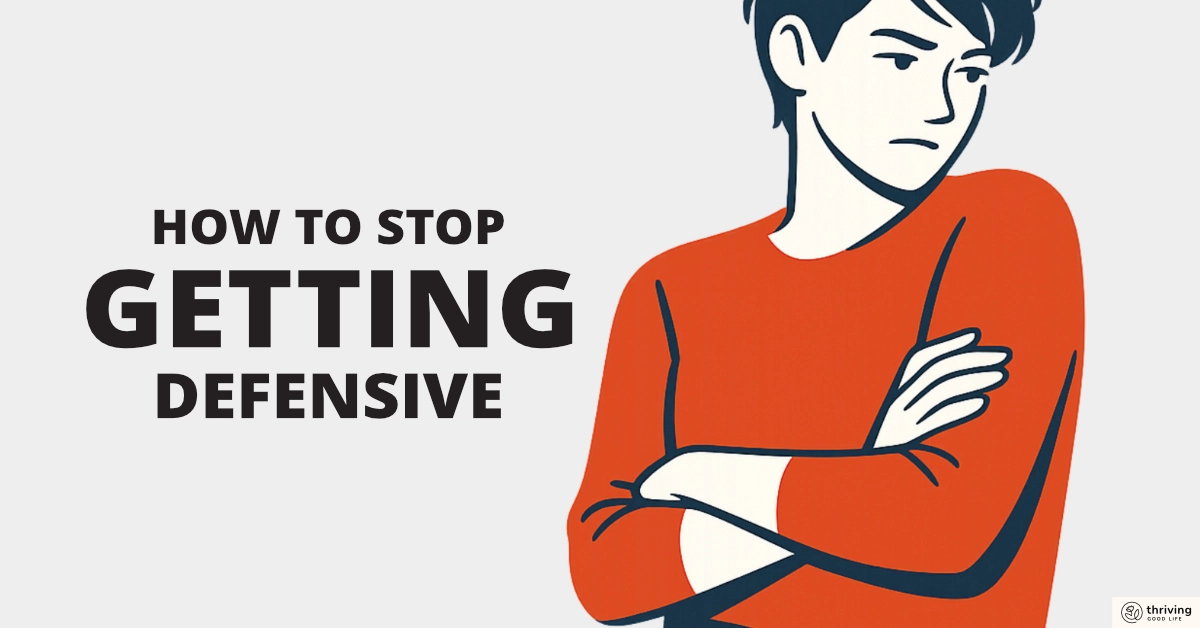

Getting defensive is a biological response, not a thinking one. The moment your brain registers a threat, even an unwanted piece of advice, it triggers a survival response that shuts rational thought down. That’s the amygdala hijack. It’s why you can’t stop getting defensive even when you know you’re doing it. But you can learn to override it.
Defensiveness has a special way of making you feel self-righteous and crappy at the same time. It also annoys the heck out of everyone around you, and solves exactly nothing.
And yet most of us rush to defend ourselves. Multiple times a week.
So if we know we’re baiting a bigger argument every time we clapback at the faintest hint of criticism, why do we get so defensive? And why do we keep doing it?
Defending Vs. Defensive Behavior
Defending yourself and being defensive are often confused, but they’re two different beasts.
The difference comes down to one thing: did you assess slowly or react fast?
Defending yourself looks like:
Listening to understand before rushing to correct. Even if what they’re saying is wrong or unfair. The main goal is to understand where they’re coming from, while keeping your boundaries and dignity intact.
There’s no overexplaining or justifying.
There’s no trying to win, or point to prove.
Defensive behavior looks like:
Jumping in before the other person’s finished to tell them they’re wrong, and bringing up unrelated issues, overexplaining and refusing to listen.
There are physical signs too. The hostile tone, the rolling of the eyes, and the final nail in the coffin – gradual shut down. Shutting down is passive defensiveness, but it’s just as deadly.
Both defending and defensiveness are attempts to stand up for yourself. But only one has the potential to wreck a relationship in under two minutes.
Not sure which one you’re doing? Here’s a quick post-snap self-check:
- Did I let them finish talking, or was I already spitting out my comeback?
- Did I really hear what they said, or did I go after their tone instead?
- Did I blow things up with “you always” or “you never”?
- Was I responding to what they said, or to what I was afraid it said about me?
How Defensiveness Destroys Relationships
One minute everything’s just about okay.
The next our inner defender comes out to play.
Defensiveness in relationships is where it does a lot of damage.
With friends who offer advice we didn’t ask for. Parents expressing concern that feels more like criticism of how you live your life. And a partner who points out something you’ve forgotten to do… again.
Not to mention the defensiveness we experience in the work of work.
Even if the advice is well-meaning, and the criticism is constructive, if we’re not ready to hear it we’ll view it as a personal attack.
We’re Great at Telling Ourselves Stories to Fill in The Gaps
When I was 11 years old, my teacher told me off in front of the whole class. She’d caught me giggling at the back with another girl, and made me move desks.
As I picked up my stuff and dragged my feet to the desk in front of the teacher, I could feel my face getting hot with the embarrassment of being singled out.
The whole time wondering, why me? Why wasn’t the other girl told off too.
In fact, it was her who had initiated the little chinwag.
My 11 year old brain concluded that this was my teacher’s way to get revenge.
No doubt something I’d done in the past that pissed her off, and now she was out to publicly punish me.
Or she just didn’t like me.
I had no evidence for either, but I didn’t need evidence.
I’d already decided what the story was.
We Jump to Story Telling Pretty Fast
The stories we tell ourselves hold an unusual kind of power over us.
When we don’t have all the information, we decide what the story is about, and how it ends. We control the narrative and can bend, twist and weave it in a way that makes us look like the hero or the persecuted one.
And because we weave the story so fast, there’s no time to process what’s really going on.
When we don’t trust that others have our best intentions in mind, we automatically default to self-protection. And defensiveness is the shield we hold up to ward off a perceived attack. The story becomes the justification for the shield.
We use these stories to say, “Well you did this, and you made me react the way I did.”
For a split-second, we think: I’m going to stay calm. I’m not going to make this a thing.
Then we make it a thing.
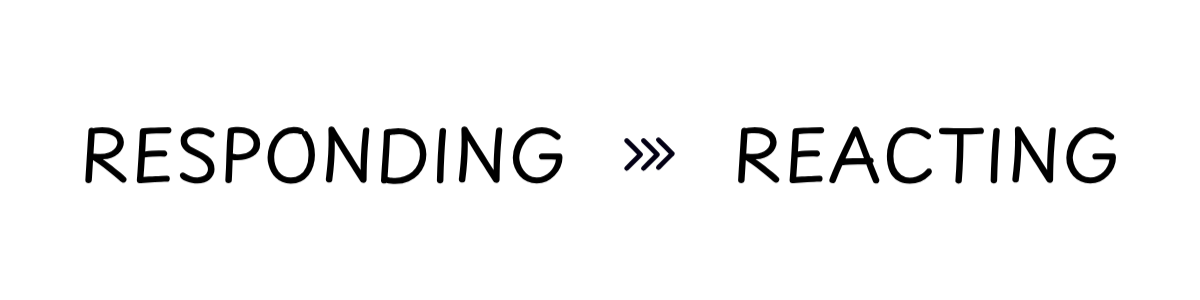
Something which feels small but isn’t really. Like a snarky retort, or a look that could shoot daggers. And then the next thing, and the next thing.
Each response a little worse than the one before it, and some part of us sees exactly what’s happening and just keeps going anyway.
Now we’re in a fully fledged verbal fight, and things get said that can’t be taken back.
All because the story we told ourselves became the truth we ran with.
Your Brain Just Left the Building
We’re wired for self-protection.
The problem is, the same system built to keep us safe and alive in the face of a potential physical attack, also kicks in during an argument.
When we feel threatened, our body prepares to fight, flee, freeze or fawn our way out of that situation. Defensiveness is us choosing to stand and fight.
The adrenaline in our body is being pumped through the blood into our arms and fists in case we need to physically defend ourselves.
And into our legs, in case shit really hits the fan and we need to flee.
The rational parts of our brain have to switch off, because everything else is busy preparing for war.
Which is all well and good when you’re facing a rabid dog, baring its sharp fangs, and oozing contaminated saliva. You could lose a limb, or two. Or your whole life.
But what’s the likelihood of that happening over a disagreement with a mild-mannered co-worker, or well-meaning friend? Someone not likely to throw hands, or end you? Someone who momentarily said something that didn’t land the way they were hoping it would.
While our body is busy preparing for combat, our logical brain has clocked out and gone home. We can’t run on biology and reason at the same time.
Our brain quickly assesses a situation and decides if we’re in danger. Then it chooses to allocate its resources to the best way to keep us safe.
This is referred to as the ‘amygdala hijack’ 1.
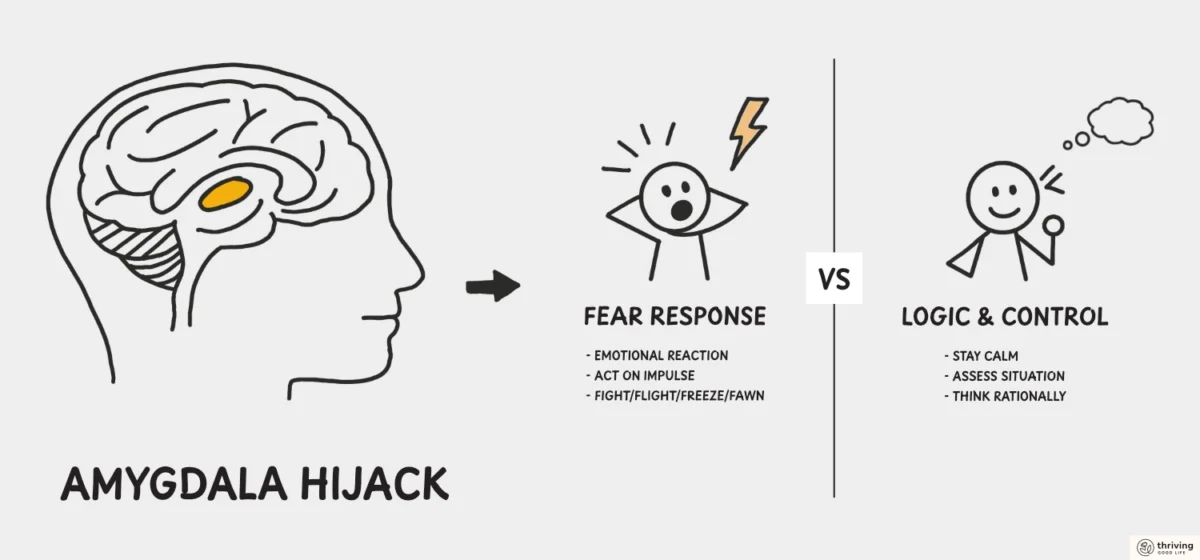
It’s why you can’t stop getting defensive, even when you know you’re doing it.
We can witness the incoming prickliness. Name it. Understand exactly what it is we’re reacting to, and still not be able to stop in the moment.
You can’t white-knuckle your way through a biological response.
So can we override any of this?
Yes. But it takes practice. A lot of deliberate practice.
How to Stop Being Defensive
First, stop kicking yourself for getting defensive. There’s not a single person on this planet who hasn’t acted on that urge.
You know it’s happening and want to stop it from happening, so let’s focus on that.
Slow Down Your Roll
I once dropped my car keys down a road drain. I watched helplessly as they rolled towards their inevitable fate… in slow motion.
I became immediately aware of which hand I had held the keys.
The way I was holding them.
The way I cursed for parking in that spot. And how my heart violently raced as I lunged for the keys, crying out “Nooooooooooo. Fuuuuck”… in slow motion.
Of course there was jack all I could do about it.
But that slow motion movie-clip made everything crazy clear.
That’s what you’re aiming for when someone says something that feels like a criticism.
The words have already been said. Reacting to that with anger is going to make them want to retaliate or shut down, and future you will feel bad.
Slow the rebuttal down before it leaves your mouth. Listen to the story you’re telling yourself, then assess how you’d like to respond.
It’s not easy to do when you’re raging, but think about the outcome you want. Do you want them to hear you, have an amicable conversation and build on mutual respect?
Or do you just want to win?
Next time someone says something that sounds like a criticism, take a slow breath for ten seconds. Focus on what your body is doing. Is your face getting hot? Heart racing? Lips tightening?
🎯 Join the Defensive… Who Me? 5-week email challenge.
Curiosity Didn’t Kill the Cat. It Gave It Wings
Ask yourself: “why are they feeling the need to say what they’re saying right now?”
Pay attention to how they respond.
Are they stressed, scared, struggling, jealous, anxious, concerned?
None of those feelings are yours. Whatever’s driving them, it belongs to them. Not you.
It’s a subtle shift. It removes any emphasis on you being the problem. And if you’re not seeing yourself as someone who’s being attacked, you won’t feel the need to defend.
It gives you space to assess their intentions.
Are they coming from a genuine place? Do you trust what they’re saying? Do you even trust and respect them? If you don’t, then does it really matter what they say to you?
Curiosity doesn’t mean you accept what they’re saying as true.
It’s data that shows you where their head’s at, and stops you from building a case against them before they’ve finished talking.
Pick someone you have little to no emotional attachment to. A grumpy cashier, a medical receptionist who stares at you like you’re an idiot for just being there. Instead of taking it personally, ask yourself: what kind of day are they having? See if that gives you wings to fly over their actions.
Don’t Just Hear Well. Listen Well
Most defensive reactions happen because we stop listening to the person and start listening to our own perspective.
We hear the words coming out of their mouth, but we’ve already decided we don’t like what they’re saying. We aren’t absorbing any validity in their message because we’ve stopped listening to them; instead, we’re listening to our interpretation of their intent, their character, and the story we’ve told ourselves about what all this means.
The more they continue to talk, the more ammunition we gather for our next comeback.
So we’ve got to learn to listen well. Not to respond or plan a counter-attack, but to understand where they’re coming from. That way, both parties get to win.
In your next conversation, resist the urge to respond until the other person has completely finished talking. No “yeah buts,” no jumping in. Just wait until they’re done.
Graciously Handle Your Response
In most situations, there are usually two sides to every difficult conversation. This, of course, doesn’t apply to extremes where there is harm or abuse.
Think of everyday situations where you’ve been on the receiving end of advice or feedback you didn’t ask for. Maybe a neighbor has taken it upon themselves to offer their two cents.
You can choose to flip out like a maniac, calmly say no to their unsolicited offers, or acknowledge they might have a point, and move on.
When you slow your roll and get curious, you’ll see how you handle yourself in tricky conversations, and whether your responses are adding fuel, or stomping out the fire.
Here are a few fire-stomping phrases:
“I see things differently.”
“I’m happy doing it this way.”
“Thanks, I’m going to leave it as is.”
“I’m not looking for advice just now, thanks.”
“I hadn’t thought of it like that.”
“Thank you for letting me know, I’ll take that on board.”
“You know what? You might be right.”
“Fair point.”
But please. Please do not add a ‘but’ after any of these.
That innocent looking conjunction erases every single word that came before the ‘but’ showed up.
Next time someone corrects you on anything, however small, use it as a chance to practice.
Pick the response that fits the situation:
If there’s any truth in what they say:
“Thanks for catching that” or “Fair point.”
If you disagree with what they say but are open:
“I hadn’t thought of it like that.”
If you’re sticking to your guns:
“I see things differently” or “I’m going to leave it as is, but I hear you.”
Then change the conversation. Talk about the weather… Maybe.
But please. Please do not add a ‘but’ after any of these.
That innocent-looking conjunction erases every single word that came before the ‘but’ showed up.
Practice Like a Concert Pianist
Okay, all of the above sounds easy on paper. What about in the real world? When it’s all going off and you’re about to lose your head.
Have you ever watched a concert pianist and thought, wow? They make playing that instrument look deliciously easy. They’re so talented.
Yeah. Partly. Talent will only get you so far though. So what you’re seeing isn’t just that.
It’s years of deliberate practice. Years of repetitive strain injury, tendonitis, trigger finger, neck, back and shoulder issues.
The practice is hardcore, but we don’t get to see the messy parts. Just the end result.
Now I’m not suggesting you go out there and injure yourself. I’m saying to get good at managing your defensiveness requires a lot of practice.
Start with low-stakes situations where getting defensive isn’t going to cost you a relationship.
As you get good at responding instead of reacting, move to high-stakes situations where you’ve got an emotional investment with the person. Like a partner, parent or friend.
But manage your expectations. You’re going to practice this with a stranger and nail it. Then you’re going to try it with your mom and completely lose your mind.
The shared history wrapped up in a whirlwind of emotions and unfinished business is going to make your nervous system fight you harder.
Real progress requires progressive difficulty. Keep at it.
Practice each of the above challenges in mid to high-stakes situations, where you have a richer emotional history with the person or people involved. Maybe it’s something you’ve been wanting to address, but bringing it up felt too difficult. Write down the desired outcome, what you plan on saying, and how you intend to react beforehand. That way you’re not scrambling in the moment.
Defensiveness doesn’t disappear overnight. But every time you catch it, pause on it, and choose differently, you’re building something.
A better relationship with the people around you, and a better version of yourself.
Join the Defensive… Who Me? Challenge
I’ve taken the five micro challenges from this post and turned them into weekly emails.
The same ideas, just spaced out to help you follow through and stay accountable.
Sign up and receive one challenge a week for five weeks.
One email. One micro practice at a time.